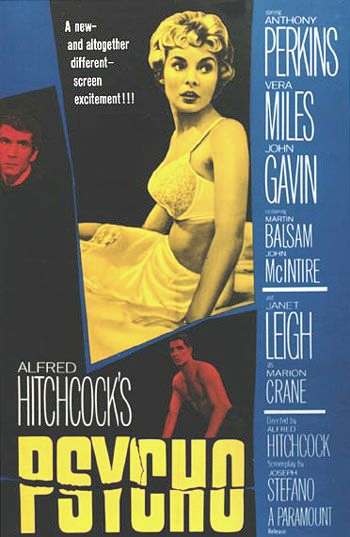
 “In a decade in which what was acceptable onscreen would change more radically than at any other time in history, Psycho was in some ways the first shot in the battle for freer filmmaking in the 1960s. Few movies of its time were more direct and unapologetic in their violence or served it up with such disorienting abruptness or tongue-in-cheek wit. With its casual depiction of sex outside marriage, fleeting nudity, bursts of shocking violence, killing off a major character less than halfway through the movie, and focus on the psychological subtext of the murderer's personality, as well as the geometric imagery of Saul Bass's credit sequence and the percussive strings of Bernard Herrmann's score, Psycho was the film with which Hitchcock left the 1950s behind and started the 1960s with relish. Time hasn't hurt the film, either; it still generates a palpable tension and the odd chemistry between Perkins and Leigh in their dinner scene is a wonder to behold. While the film is still frightening after all these years, repeated screenings reveal a cold-blooded humor; with Psycho, Hitchcock tore asunder the audience's expectations of what a suspense film should be, and he appears to have had a wonderful time doing it. ~ Mark Deming, All Movie Guide” – Mark Deming
“Why remake PSYCHO?For almost four decades the very concept of motion picture suspense has been synonymous with the title Psycho. When Alfred Hitchcock originally made Psycho in 1960, it was the most frankly sexual and violent motion picture ever made by Hollywood, frighteningly so. Audiences were stunned by the stark portrait of a maniacal killer, and thousands thought twice about their personal hygiene choices after the relentless experience. Since then, the techniques Hitchcock used to compel viewers to the edges of their seats have been often imitated yet nothing could ever usurp the first-time viewing of Psycho. In fact, the movie was recently named the second most scariest movie ever made in a TV Guide poll and was chosen by the American Film Institute for its list of the 100 most important American movies.
Psycho penetrated deeply, indelibly, under the skin of all who entered the lurid yet undeniably alluring world of the Bates Motel, overseen by its unusual owners Norman Bates and his elderly, domineering mot
 her. This effect was entirely due to the taut, suspenseful screenplay by Joseph Stefano and the masterful filmmaking of Hitchcock, whose voyeuristic camera, staccato cuts and willingness to plunge fully into the darkest recesses of human psychology made the film unlike any cinematic experience that had come before. By all accounts, Psycho was then and remains today a masterpiece. So why would anyone mess with it? Director Gus Van Sant has stood up to one of the biggest taboos in contemporary filmmaking by recreating the motion picture Psycho. Although it has never been done before, Van Sant was intrigued by the notion of taking an intact, undeniable classic and seeing what would happen if it were made again-with a nearly identical shooting script-but with contemporary filmmaking techniques. Part tribute to Hitchcock, part new introduction for younger audiences, part bold experiment, the recreated Psycho is not even remotely intended to supplant the 1960 masterwork. Rather it is a fresh look-a sort of inquiry into what happens when someone from a new generation wields the same razor-sharp blade. Gus Van Sant has had a Psycho fixation for a long time. It all began when he started thinking about the notion of Hollywood remakes. Van Sant noticed that, almost without exception, only those films that had fallen out of popularity, relegated to lonely midnight movies and late-night cable, were ever remade. Big, enduring classics were rarely tackled, except in cases where they were altered beyond recognition. Van Sant, known for his bold choices in filmmaking, wanted to take on the challenge of truly recreating an incredible, landmark movie, in the same way that different directors repeatedly tackle the material of Shakespeare's Hamlet because it is so rich and resonant. He chose the ultimate American classic: Psycho, a film that had been far ahead of its time in 1960 and still surprises viewers today. The initial reaction from almost all quarters was astonishment: "Why on earth would you want to do that?" Some thought it outrageous, others thought it sacrilege. But Van Sant had an answer. "I felt that, sure, there were film students, cinephiles and people in the business who were familiar with Psycho but that there was also a whole generation of movie-goers who probably hadn't seen it," he says. "I thought this was a way of popularizing a classic, a way I'd never seen before. It was like staging a contemporary production of a classic play while remaining true to the original." Like many film-watchers of his generation, Van Sant first saw Hitchcock's Psycho on television. It wasn't until years later that he got the opportunity to enter the full-scale nightmare on the big screen, and then only because he was a film student. He wondered if millions of potential Psycho viewers of the future would ever have a chance to check into the Bates Motel on the big screen, and if they would increasingly be put off by the film's 60s-era film stock, fashions and mores. He continues: "There is an attitude that cinema is a relatively new art and therefore there's no reason to 'restage' a film. But as cinema gets older there is also an audience that is increasingly unpracticed at watching old films, silent films, black and white films. Psycho is perfect to refashion as a modern piece. Reflections are a major theme in the original, with mirrors everywhere, characters who reflect each other. This version holds up a mirror to the original film: it's sort of its schizophrenic twin." As Van Sant began to formulate his argument for a 1990s Psycho recreation, the reaction from Universal Pictures (which owns the material), the Hitchcock estate, screenwriter Joseph Stefano and Van Sant's new producing partner Brian Grazer of Imagine Entertainment, began to bolster his ambitions. Grazer was one of the project's earliest champions, having had his own fascination with it. Says Grazer: "I always saw Psycho as being the first truly scary movie that operated independent of time. It doesn't deal with trends or fashions; the drama, suspense and horror work independently of any particular era. I liked the idea that Gus would follow Hitchcock's lead taking the same script, the same basic plans for the sets, the same schedule and infuse it with a new sensibility, with different actors." "Of course in theatre, that happens all the time because it's not only the production we value but the play itself," he continues. "Restating it offers people the opportunity to re-experience a great work. And now we're experimenting, trying to do the same thing with a film." Adds executive producer Dany Wolf: "Alfred Hitchcock's Psycho is something that's precious to everybody here and something Universal is very proud of. But it seemed possible to do this and at the same time be very reverential in our treatment of the film." But the real test for Van Sant came in approaching those who had worked with Hitchcock in 1960. Would they call foul and protest? Patricia Hitchcock O'Connell, the director's daughter who also acted in the original film and serves as technical consultant on the current one, set the tone by opining: "I think it's very flattering. I know my father would be flattered that Psycho is considered such a great movie that it deserves to be remade. My father always made his pictures for the audience. He didn't make them for the critics. He didn't make them for himself. His number one reason was the audience and audiences don't change." She adds: "Of course every director has his own style. I think Gus' style is great and I think my father's was great. Seeing Gus remake my father's picture in his own style has been fascinating to watch." As for others, typical of the reaction was this from Marshall Schlom, the original script supervisor. "When I got the call," recalls Schlom, "I just didn't really believe what I was hearing. Gus Van Sant wanted to do an homage to Hitchcock. The film was essentially going to be the same film we shot, just brought up-to-date. I thought of it as an indication of how much this film has meant to people. It will offer young people today an opportunity to see it and maybe they will also go back and watch the original." He continues: "When we were shooting the film in 1959, we didn't know we were making a classic. It didn't cost much money. Mr. Hitchcock made it with his television film crew. It didn't seem to have the magnitude of Rear Window or North by Northwest. It was just a little picture. And you should see it in those terms-just as if you were being led down a garden path beautifully by a man who wants to tell you a story." To go for that same purity of experience audiences received in 1960-being led down the garden path to somewhere chillingly dark and horrifying-Van Sant hoped to use Joseph Stefano's original shooting script. But the question remained: would the writer of one of the most analyzed, imitated and psychologically rich scripts ever in American cinema be interested in a revisitation of his work?”
“http://www.psychomovie.com/production/productionwhy.html”
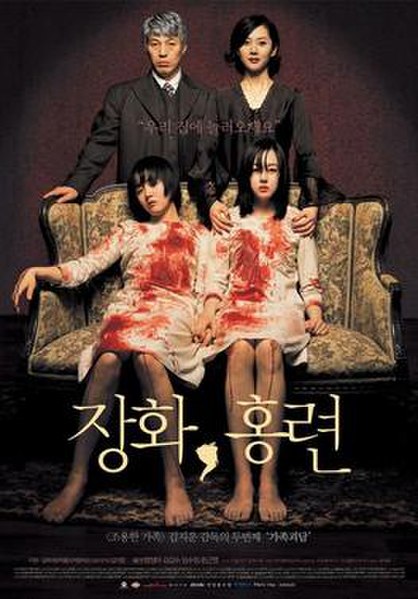
2) The tale of two sisters (2003)

“The success of the 1998 film ‘Ring’ brought the image of the Asian horror to Western popular culture for the first time. More and more people get to know Korean horror movies. Korean horror movies or K-horror have become the new attraction to people around the world besides “Hallyu” stars, and Korean dramas”.
“After enjoying "The Ring" all those years ago, Korean/Japanese horror to me are some of the most amazing movies, and when I saw the cover to "A Tale Of Two Sisters" and the reviews all over the net were nothing short of excellent, you were going to be treated with a great movie. Gut-wrenching, very chilling, weird, nasty, sweet, beautifully shot, sad, violent, to me it's one of the best”.
“ I wont spoil the ending for those who haven’t seen it. If I could remember it right, this was released in theaters here in the Philippines last 2003. The film was painfully slow. It was terribly paced and was neurotically deceiving. We watched it sa Dorm packed with blankets and we even turned the lights off ready for the scare. We were hoping so much (kasagsagan kasi ng Asian Horror films), and lot of us were disappointed for not getting the goosebumps that we expected. But aside from the turtle fast screenplay, I have no bad blood for the movie. The ending was perfectly executed and I didnt see it coming at all.
Now! This film would be joining the list of films like The Grudge, The Eye, Shutter, Darkwater and our very own of Sigaw. It would now have its very own Hollywood version (I have high hopes for the film SIGAW since unlike the rest on the list, it would still be directed by the original Filipino director, YAM LARANAS). I am just hoping that this would turn out good. Hollywood has that hobby of making the story their own, leaving it messy and undeniably nakakabobo… in english … nakaka-dumb (hehehehe)!!!
Please welcome… Hollywood’s version of The Tale of Two Sisters!!!
I don’t know why, but they also changed the title to "The Uninvited"! One good thing though, is that they were able to consider the main element in casting the 2 main characters. Playing the lead roles would be Arielle Kebbel as the older sister and Emily Browning (I love her lips, it’s effortlessly soooo Angelina Jolie) as the younger one. Both sisters need to be pretty and innocent looking and I guess the 2 actresses are suited to that.
I am just hoping that they would be able to match the cinematography of the Korean version. For me, the Korean version was a visual feast. A lot of scenes were beautifully shot. A good contrast between staggerring emotions was executed. Your eyes would be treated by innocent lovely shots for you not to expect the thrills and the horrors that are about to come on the following scenes. The mystery was established that way and the trick was played really well. I wish that Hollywood would respect the Asian material. Let’s just hope that this won’t be another tale forgotten.”
3) Jaws (1975)
 “Shooting on Martha's Vineyard with a mechanical shark dubbed "Bruce," 27-year-old Steven Spielberg wanted to shoot Jaws on the open water for as much terrifying realism as possible. Between rewrites of Robert Benchley's and Carl Gottlieb's script, the unruly ocean, and the glitch-laden shark, the shoot went way over schedule and the budget ballooned to $10 million, leading everyone to believe that they had a B-movie disaster on their hands. However, Spielberg and editor Verna Fields turned the liability of an obviously fake Bruce into a potent source of fear by leaving the shark unseen until the final battle. Instead, swift cuts between swimmers above the surface and underwater shark's-eye views of helplessly dangling legs, combined with John Williams's pounding score, create a relentless atmosphere of primal horror. With an ad image of a giant shark aiming for a tiny female, Universal Studios aggressively marketed Jaws as a thrilling "event," especially in primetime spots on TV, a then seldom-used advertising venue for movies. Bucking the old practice of using wide releases for stinkers, Universal opened the heavily-anticipated film in over 400 theaters in June 1975, and it shattered box office records. Tapping into an abiding dread of the unknown, made scarier by the reality of Great White sharks and corrupt bureaucrats as well as by Spielberg's effective orchestration of excitement, Jaws became the first film ever to return over $100 million to its studio. Producers David Brown and Richard D. Zanuck received a Best Picture Oscar nomination, but wunderkind Spielberg was passed over for Best Director. The film's technical achievements were rewarded with Oscars for Editing, Sound, and Score. With the lines at the box office, the proliferation of Jaws products, and a rash of reported shark attacks, Jaws became a cultural phenomenon and the first bona fide summer event movie, leading the thrill-packed and profitable way for summers to come” – Lucia Bozzola
Exorcist + Jaws Make Hollywood Museum's Horror Hit List
30 October 2008 6:29 PM, PDT From wenn.com See recent WENN news
The Exorcist, Jaws, Halloween and Friday The 13th have been named among the top 10 horror films of all time by the curator of a new Hollywood Museum exhibit.
Memorabilia from the films selected by entertainment journalist Tom O'Neil will be shown at the Chamber of Horrors exhibit, housed at the famous museum.
Film expert O'Neil includes silver screen classics like 1963's The Haunting and The Mummy from 1932 among the top 10 Halloween film frights.
His list also includes Nightmare on Elm Street, Psycho, The Shining and The Silence of the Lambs
4) Halloween
 With its almost blood-free frights, gutsy heroine, and peerless score, Halloween became the gold
standard for the late 1970s-1980s teen slasher cycle (as Scream cheekily acknowledged in 1996). Taking full advantage of the widescreen frame (and offscreen space), John Carpenter builds tension through the constant suggestion that something terrible lurks just out of Laurie's and the audience's view, whether it's behind a bush or in a passing car. Carpenter also shifts to the killer's point of view, leaving the audience with only the sight of the unaware victim and the sound of Michael's breathing. Evoking Alfred Hitchcock's Psycho and Vertigo, as well as Howard Hawks's original The Thing, Carpenter and co-writer/producer Debra Hill render Myers an inhuman force that paradoxically points up the psycho-sexual anxieties under the surface of small-town life, especially in the wake of the late '60s-early '70s sexual revolution. Teens responded to Halloween's thrills, as the $325,000 indie film went on to gross $47 million, begetting six sequels and numerous imitators like the Friday the 13th series. ~ Lucia Bozzola